
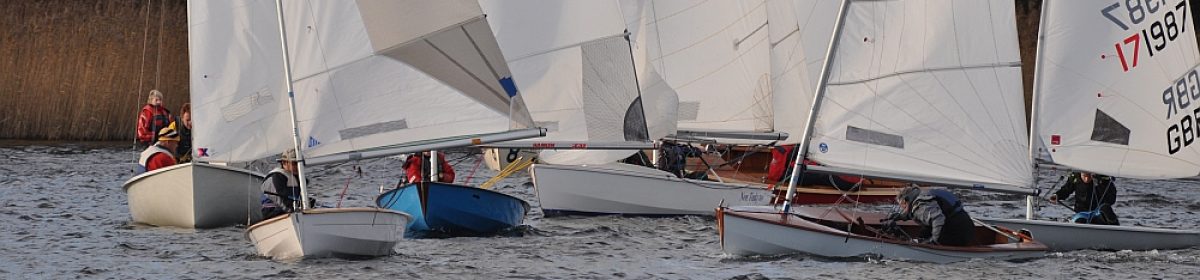
All Our Yesterdays 1971 – 1983
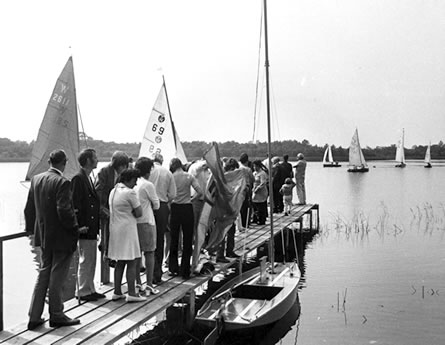 The first move to make use of the local broads for recreational purposes as made by the Ormesby Society, which existed to improve the amenities of the village.
Arthur Marfleet proposed that an attempt should be made to obtain permission to establish a sailing club on Ormesby Broad. This suggestion was accepted and preliminary, exploratory work was undertaken by Ray Green, reporting back to the Ormesby Society on 20 September 1971. The report was discussed by the Parish Council of Ormesby with Scratby in the following month.
There was an oral tradition that a public staithe existed on Ormesby Broad but it had long been disused. The Broad was a reservoir used and owned by the East Anglian Water Company, who did not accept that there was any right of public access. The legal position of who, if anybody, in addition to the Water Company had a right to use the Broad was, and still remains, obscure.
| On 19 November 1971 the interested parties, Ray Green from the Ormesby Society, Edgar Tennant from the Parish Council and Jack Boon, the Managing Director of the Water Company met in the Water Company’s Offices. They reached agreement it would be good to allow sailing on one of the local broads.By 17 December 1971 the Water Company decided to allow, and actively support, sailing under controlled conditions on Rollesby Broad only. Lily Broad was excluded for environmental reasons and Ormesby because so much of it is shallow. Once this agreement was secured Ray Geen, who was not interested in sailing, wanted to opt out, but agreed to continue until the club was in being.
Implementing the agreement became the responsibility of Arthur Marfleet. He set to work, forming a steering committee: As he was new to the village, he looked round for a well-known, respected older inhabitant, interested in sailing to chair the steering committee. He found Alec Batte from Birdseye, who in turn imported Roy Simmons, whose practical engineering knowledge proved invaluable. The remainder of the committee consisted of members of the Ormesby Society and parish councillors. |
The steering committee met in February 1972 and discussed finance, planning and the need for a public meeting to sound out support for the idea of a club. They met again in April, by which time the Water Company had agreed to pay for opening up a road to the site.The public meeting took place on 17 April 1972 and was attended by 72 people, mostly from Ormesby and Scratby, but some from Rollesby and three from Caister. The decision was taken to go ahead. Syd Sharrock volunteered to become the secretary.
The Parish Council members now withdrew from the steering committee and other interested sailors took their place. On 15 May 1972 the first club meeting took place and a reformed steering committee was instructed to carry on. Incidentally, the fees decided upon, with some fears that we might be pricing ourselves out of the market, were… Entrance: £1, Family: £4, Husband/Wife: £3, Single: £2 , Junior: £1 There were 69 adult and 34 junior members at the original 50p joining fee. It was a fairly brave decision to start a sailing club on a capital of £52-50! |
The steering committee had two main tasks: to agree with the Water Company the terms of a lease and the club constitution and to turn a wild wood and a marsh into a site for a sailing club.
The prospect was daunting. To get to the water’s edge from the nearest hard road it was necessary to traverse a field, then 150 yards of woodland with thick undergrowth, and then 50 yards of marsh. During the summer of 1972 a road was laid across the field, the undergrowth and sufficient trees were cleared to form a car park, roadways and dinghy berths. A causeway was built across the marsh to the water’s edge. As an illustration of the physical labour involved, the trunks of several hundred trees were placed in the marsh to form the base for the 125 tons of hard-core used for the causeway.
| All this labour was done by a small band of volunteers led by Roy Simmons and including Richard Tacon who came with a tractor and power saw, Ron King, John Gray, Arthur Marfleet, Gerry Miles and Tony Wilkin.They went on to build a slipway out of railway sleepers and then the main jetty much as it is today.
This small band, reinforced from time to time by others, worked all through 1972 on every Saturday and Sunday from 9 – 1. They were operating without any facilities, shelter or apparatus except what they brought with them. The only concession to human weakness was the presence of two Elsan toilets in sheds, one of which later became the first starting box. By July 23 enough had been done to make sailing possible and the Club was officially opened by Mr Tom Watson. ‘Please come and picnic on the site, launch your boat and sail… Since we have at present no facilities please bring your own refreshments.’ For the rest of the 1972 season sailing went on a casual basis until what was then the last day of the season – 29 October 1972 – when the club held its first race. Meanwhile the non-physical side of the club had been taking shape. The Water Company were now whole-heartedly behind the project. In a series of discussions with environmentalists, fishermen and the inhabitants of Burghwood Road they endeavoured to ensure that as far as possible existing interests were protected and that all those affected by the change of use of the site were kept happy about it. There are no records of actual discussions with the Great Crested Grebe, but its family life was protected from disruption by the exclusion from our sailing water of Lily (or ‘Lady’) Broad. It was agreed that no fishing; should be allowed from the club or from club boats and a gentleman’s agreement was established that sailing craft would keep well clear of boats fishing. It was also agreed that we would not be allowed to use rowing boats, canoes or rubber dinghies from the club. ‘Acceptable’ boats were open centreboard dinghies up to l8′ in length overall. They were to be berthed ashore. |
Burghwood Road was a more difficult problem. At least one inhabitant, Mr French, had bought his house there because he would be traffic free and have access for fishing to Broads where nothing else went on. All the residents were worried about the extra wear and tear on the road surface and the dust and traffic nuisance. The Water Company met the last point by undertaking to maintain the road and the club agreed to enforce a 10-mph speed limit between the Main Road and the club, and appointed one of the residents, Ron King to the committee to represent the residentsThe club committee, which included two members of the East Anglian Water Company: Jack Fitch and Keith Clarke, produced a constitution and a set of rules. Before these were completed, it had become clear that the club would not get more than fifty local memberships, which would never be enough to support class racing or provide the kind of facilities everybody wanted. The Water Company had no interest in ‘just another sailing club’ and every interest in making sure that the key- holders of the three villages (Ormesby St Margaret with Scratby, Ormesby St Michael and Rollesby) retained control of the club that had been founded for the express purpose of providing them with sailing and the unexpressed purpose of defusing the agitation about public staithes.
The Club Rules therefore as originally drafted created two kinds of membership: full for the key-holders of the riparian villages and annual for those living elsewhere. Annual members were barred from the committee and therefore from being club officers and had no votes at the AGM. The object of this device was to prevent the control of the club from passing out of the hands of the villagers for whose benefit it had been established. The first annual members were accepted in August 1972 bringing the club membership to 94 adults and 42 juniors. From the beginning the club was a Do-it-Ourselves institution. Members were expected to give their time and skills to the building up of a viable sailing club. It was also a family club with children as welcome as adults, and it was a sailing club, not a racing club, though, of course, many members wanted to race. |
The 1973 season saw the first regular racing. At the last meeting of the previous year a very ambitious programme was projected: 3Allcomers races every Sunday, 2 races every Wednesday, training races on Wednesday afternoons. There was no clubhouse and no starter’s box, but the flagpole had been planted in the mud – Arthur Marfleet dug the hole and had disappeared from sight before it was deep enough. His back, he says, will never be the same again. Syd Sharrock sat at a table under the flagstaff controlling and recording the races in all weathers. There was nothing under his feet but mud, and the job must have been a little uncomfortable in the rain. During the summer of 1973 the Water Company erected the shell of the clubhouse and as they watched it being put together the picnic parties on the mud flat outside could begin to see that better things were on the way.
Over the first two years too there was a good deal of discussion about what classes of dinghy we were anxious to encourage on the one hand and unwilling to accept on the other. Multihulls were banned but on the positive side, the committee decided to wait and see and their patience was rewarded over the years as very sizeable Enterprise and Wayfarer fleets built up.
In May 1973 the Sailing Committee was set up. The idea was that through this channel, annual members could participate in running the aspect of the club they were most interested in – the sailing and especially the racing.
That November saw the second AGM and the first Annual Dinner Dance and Prizegiving – a strengthening exercise for more strenuous winter work in 1973-74 when an excavator was hired to dredge the pool and the spoil spread over the site the hard way. In addition to this, the interior of the clubhouse was painted (i/c Gerry Miles), the lawn was turfed and seeded, more berths were cleared and a second boat access road and slip constructed.
At the 1973 AGM the Club had 162 memberships, mostly family or husband and wife.
1974 saw quite a bit of further progress. The Clubhouse now connected up to electrical and water services and with its own sewage disposal system, was formally opened by Jack Boon on 7 July. Furniture had been purchased and the tea-bar planned but not constructed.
During this summer a start was made in building the south jetty.
In October 1974 permission was obtained to sail on the Eel’s Foot Broad.
For the first two seasons the only rescue facilities were what could be provided by Syd Sharrock’s private launch, which did sterling service but was not very fast. In 1974 the club used an inflatable dinghy powered by a series of borrowed engines.
This too did good service but by the end of the season the committee were convinced that a proper dory was essential
Up to this point Syd Sharrock was the secretary, timekeeper, treasurer and secretary of the Sailing Committee. He had had a good deal of help with the time keeping from Susan Humphrey but this was no longer forthcoming. An attempt was made to relieve him of some of this load by a system of duty officers but it was not entirely successful. The position was eased a little at the 1974 AGM when Gerry Miles became the treasurer.
When the clubhouse was available for use the two outside toilets were thankfully scrapped but the sheds were thriftily reused: one as a store and the other converted to a starting box. In the winter of 1975 this converted shed was raised about four feet off the ground on to a homemade platform of telegraph poles and railway sleepers.
The play area for children was started.
Mooring facilities were extended by the construction of homemade pontoons – sizeable -platforms with eight 50-gallon oil drums for buoyancy. They were difficult to launch at the beginning of the season, almost impossible to moor securely, unstable, and difficult to recover at the end of the season.
Also in early 1975 the first stage of the tea-bar was constructed and when the season started Marjorie Smith began to be seen where she now appears to be almost a permanent fixture.
An attempt was made to ensure that all boats using the Broad were buoyancy tested and insured, at least for third party risks.
By July the outside toilets – another gift from the Water Company – were available for use and weekday sailing became a good deal more convenient.
There were a number of other small improvements too:
the flowerbeds were planted up, the telephone acquired its hood and the rescue boat engine its trolley and a home outside the clubhouse in the second old toilet shed.
The innovation during the sailing season was that we played host to the Silver Streaks International Championship. The distinction was a little less than it seemed because there are no Silver Streaks outside England and precious few outside Norfolk but it was an international event is theory if not in fact and it was won by our very own David Saunders.
The north launching slip was rebuilt and concreted.
The next year, 1976, started with the winter of the roads and berths. The two side roads and cross access roads were made up with rubble broken down by hand with sledgehammers. It was not exactly light work but when the hoggin had been rolled in we had for the first time a road system that worked in wet or dry weather.
While this was going on, a berthing plan had been made and numbered concrete slabs were put out to mark berths.
A few spare slabs were laid along the front of the clubhouse to save some wear and tear on the lawn, and the concrete posts marking the car park area were put up.
The mooring pontoons were still in use and some time was spent on patching them up. In July we got our outside seats. In the month dogs and litter were mentioned as problems.
The club was by now so successful that we were in danger of getting more members than we could cope with and so the first waiting list was started. The decision was also taken not to allow temporary memberships and not to allow the occasional visitor to bring his own boat.
The committee were also beginning to worry about the extension or renewal of our Licence, which had initially been for a two to five year period. However, by June 1976 we had been offered a 99-year Licence coming into operation in 1978 and so that problem was happily solved
Winter work in 1977 consisted in making improvements to the car park, adding to the tea-bar and kitchen arrangements and relaying the flooring in the clubhouse.
By this time the financial position of the club was pretty secure and it was possible to establish a reserve fund of £1,000 against the day when a new rescue boat or engine might be urgently needed.
Later in 1977 the changing rooms arrived yet another generous gift from the Water Company – and Bob Haines took charge of fitting them out. We also bought and erected the climbing frame, which was paid for by profits from the tea-bar.
Then we had our first club row, on the extraordinary subject of dogs. These animals generated an amazing amount of heat. Dog lovers rallied to the support of their pets as if they were a threatened species. Dog haters’ claimed to be scarcely able to pick their way across the site for mountains of excrement. The outcome was reasonable enough. Members may still bring their dogs, though we would rather they did not, but must keep them on a lead and be responsible for clearing up any mess they make. But it took two resignations and three committee meetings before this solution was reached – a rather painful object lesson in how not to handle a contentious issue.
By contrast, 1978 was, for the first ten months, a quiet year. We bought a few knives and forks and some more clubhouse chairs and we planted 1,000 or so daffodils in the woods. All nice peaceful stuff and then in October Syd Sharrock resigned leaving us without a secretary, sailing secretary or timekeeper.
The committee took the obvious view that we had been remiss in loading so many burdens on to even such a willing horse, and so the jobs were divided up. John Bright became general secretary, Norman Bambra became sailing secretary and Frank Daly agreed to be timekeeper until the end of the season. It was c1ear that 0.Ds would have to accept full responsibility for the racing on their duty days in future, and, to duty days in future, and, to anticipate a little, of course they did.
In the winter working period of 1979 we enlarged the car park up to a new extended boundary generously agreed by the Water Company, but come the beginning of the season, old habits prevailed and the extension reverted to bush. We also tried to solve the problem of leaks between the skins of the rescue dory by filling the space with expanding polystyrene foam. At the same time we filled the pontoon drums in the hope that we should have less trouble with leaks and instability. Halfway through the operation we had a change of mind and added an extension to the south jetty instead, leaving us in the new season with the need for only one pontoon – north of the north landing slip for use in northerly winds.
Before the season started we got the south slipway concreted and the block and tackle set up. We bought some wineglasses and the rabbits ate the wallflowers and had to be kept at bay with wire netting.
During the season we tried team racing against other clubs for the first time. We established the Rollesby Broad Challenge Trophy and invited the Norwich Frostbites and Hickling to bring along some Enterprises and sail against us. They did and the Frostbites won the trophy and then forgot all about it! We eventually wrote and asked for it back at the end of 1981. In the summer of 1979 there was an increase in class racing to the point where we occasionally had difficulty in raising three boats for the Allcomers.
But perhaps the most interesting increase was in Saturday sailing. There were nearly as many boats on the water on Saturdays as on Sundays. It seemed desirable to do something for the comfort of these members, who did not enjoy sitting outside a locked Clubhouse especially in the rain, and to do something more about safety since the main rescue boat was only available on racing days.
The first problem was solved by issuing keys to two regular Saturday sailors, and the second by the purchase of a small fibreglass dinghy ‘Rescue II’ and later a 5 HP Seagull for her. At the same time an emergency telephone was installed outside the north wall of the Clubhouse to accept 999 calls only. With Syd Sharrock continuing to provide back-up facilities with his own launch on weekdays, the committee felt that they had done what they could. They have always emphasised, of course, that the safety of boats and crews is the responsibility of the master, who should not go afloat in conditions he cannot handle, or when there is no one else on the bank to help if he does get into trouble.
In 1979 we joined the RYA and one of the first results was that we abandoned our attempts at buoyancy testing all boats by officers of the club. This had never worked satisfactorily, less than half the boats ever having been tested in anyone season and we were advised that in the event of an accident we might find we had incurred some legal liability if we did the testing as a club. The decision was taken to require a buoyancy and insurance affidavit from every member annually. This has removed liability from the club; whether it has led to buoyancy being better maintained is another question.
1979 was also the year of the Yogisgang mystery. Yogisgang was an Enterprise and when she disappeared from the site we were unable to trace her owner. The boat, we discovered, was sold at Oulton Boat Sale. The moral was obviously that our boat register was inadequately maintained and a form was designed to give the secretary information annually about all the boats owned by members.
The Evinrude outboard on the rescue boat gave rather a lot of trouble and we replaced it with a Mercury, more suitable for our purposes because it will idle without oiling up its plugs.
During 1979 we ran out of copies of the club rules and before they were reduplicated the opportunity was taken to bring them up to date by including committee decisions taken since they were drafted.
Towards the end of 1979 discussions started about the possibility of a new starting box. David Phillips was consulted and produced an attractive plan, if we could find some way of paying for it.
At the first committee meeting in 1980 we took a deep breath and authorised expenditure up to £4,000 on the starting box. We immediately appealed to members for interest-free loans to help to finance the project. By the AGM a fortnight later the first contributions had been received and by the summer we knew that our faith had been justified.
The main winter work in 1980 was the construction of the new north jetty, christened the Norwich jetty because of the amount of work done on it by our Norwich and Norwich Union members. The same team built the final extension on the south jetty and we were thankfully able to say goodbye to the pontoons.
Our very junior members had gradually over the years been excavating themselves a sandpit beside the old starting hut. We reinforced their efforts a little that winter.
During the season Brian Hurren built us a clock that records in seconds and simplifies the time keeping by making it possible to work out handicaps on a calculator instead of by arithmetic and the Langstone tables.
The Committee ruled that we would not accept sailboards. We played host to the Norfolk 14′ OD Dinghy Championship.
The Sailing Secretary became ex-officio a member of the general committee.
By the autumn of 1980 all the necessary planning permissions had been obtained and Ron Pearce was able to start on the erection of the new starter’s box. The foundations were laid. Then there was difficulty getting the girders.
However they went up in due course and the rest followed quickly. The only remaining snag was the stairs, which as originally planned proved impossibly expensive. This problem was still unsolved at the beginning of the 1981 season, though we had several members working on the possibilities of building wooden stairs or getting hold of scrap.
The eventual solution was provided by Jack Heron, who found an iron staircase on a scrapyard in Norwich, and Ron Pearce whose ingenuity adapted it to make what we now have.
Before that though we had the 1981 AGM, where the most significant announcement was that the Water Company had agreed to allow up to one third of the elected places on the general committee to be filled by annual members and no longer had any objection to annual members being flag officers provided that either the Commodore or the Vice-Commodore should be a full member in anyone year. This concession should be a real help to the club because we are not yet an old enough club to have a large pool of retired members on whose goodwill we can draw for the tasks involved in running the club.
1981 winter work consisted of painting and fitting out the starter’s box and setting up a new signalling system. Meanwhile the Norwich gang repaired the south jetty and made improved landing facilities for Lasers by levelling and strengthening the south bank, which had been quite seriously eroded by wave action.
Some more work was done on the car park extension: weeds were cleared and rubble spread to make a firm surface.
In the sailing we made one unsuccessful experiment: the introduction of two special days when points racing did not take place. A large number of usually regular helmsmen apparently decided that the opportunity to get on with the garden or just stay in bed without losing points was too good to miss.
We also hosted the Broads Junior Enterprise Championships for the first time and with sufficient success for them to be anxious to return next year.
In the middle of the year the treasurer was able to repay half the loans from members.
Towards the end of the year we purchased a second-hand rescue dory in excellent condition. It has remote steering control and has already proved much easier to manoeuvre than any of its predecessors.
(Draft to this point made by John Bright and completed 13 January 1982.)
1982
Winter work: The secretary, Betty Brown reports:
Working parties in 1982 completed repairs to the bank beside the North jetty, drainage to the ‘Wayfarer site, cleaning up the car park and the making and installation of an anemometer.
Membership numbers were maintained and at the end of the season stood at 215 (excluding honorary members) with a waiting list of l6 for 1983.
The Treasurer succeeded in repaying all the outstanding loans from members and had no sooner done so than we were faced for the first time with a demand for rates. An appeal against the assessment is pending but we are certain to have to pay a not inconsiderable sum in future years and have been forced to increase subscriptions to Family – £15, H/W – £l3, Single – £11, Entrance –
£20. Juniors – £5 and £5.
In spite of our full membership slightly fewer boats turned out to race than in the previous year. It turned out to be the year of the younger members at the Club, and outside; Keith Boggis did well with Mark Tincombe in the Three Rivers and Jayne Lewis in the Schools Regatta and in the National Schools Regatta at Northampton.
We hosted the Woodcock Salver, The Broads Junior Enterprise and an invitation Wayfarer meeting, where Chris Sallis finished third overall.
11) 1983 J Bright reports:
During the winter work the Berthing Master, David Hampshire, relayed and renumbered the berth slabs and cleared berths by pruning back overhanging branches.
Keith Sarsby was mainly responsible for the installation of a louder audible warning device in the starting box and a water heater.
Eddie Brown raised the height of the anemometer vanes to give a truer reading.
The ladies’ changing room was extended by taking the former engine shed. The rescue boat engine was moved to the little shed, the padlock of which was changed so that it could be opened with the main gate key. This provided access to rescue facilities when the clubhouse was locked.
Repairs were made to the landward end of the main jetty.
The East Anglian Water Company continued to provide generous support. They made a donation amounting to half the total towards the first rates bill, renewed the Clubhouse doors and
rehung them to open inwards, renewed a great deal of rotten timbering and repainted the Clubhouse.
During the year we obtained a radio licence and aided by Roy Chastney’s gift of a surplus two-way radio and Phil Cooper installed two-way communication between the box and the rescue boat.
The sailing committee was elected for the first time at a special general meeting held immediately before the twelth AGM.
At this AGM an annual member, Norman Bambra, became Commodore for the first time in the Club’s history.